
Senior cat care · new or persistent bad breath
Senior Cat Bad Breath? Call Before Treating the Smell
An occasional food smell can be harmless, but bad breath that persists or keeps returning in an older cat deserves a veterinary check. The smell cannot tell you which problem is present or which home treatment is safe. Cornell's feline health guidance notes that healthy cat breath should not be offensive and that oral and non-oral problems can be involved. Do not use a breath freshener as a diagnostic test or a reason to delay the call.

Bad breath is a sign, not a diagnosis
Periodontal disease is one possible explanation, but the odor alone does not prove that it is the cause. VCA's halitosis guidance describes the need for a thorough professional oral examination rather than a scent-matching exercise.
The useful question is not “Which disease smells like this?” It is “What changed, and what else have I already noticed?” A smell can be worth reporting even when your cat still wants food. One sign also cannot tell you how serious the underlying problem is.
| Already observed | Not established by the smell |
|---|---|
| Breath is newly or consistently different from usual | “It must be dental disease” |
| Drooling, food falling while chewing, eating difficulty, or another change you saw | “No other sign means it is harmless” |
| When you first noticed the odor and whether it keeps returning | “A freshening product will identify or fix the cause” |
Do not force your cat's mouth open, probe a sore-looking area, or keep repeating a check to get a better look. Describe what was already visible and let the veterinary team decide how the mouth should be examined.
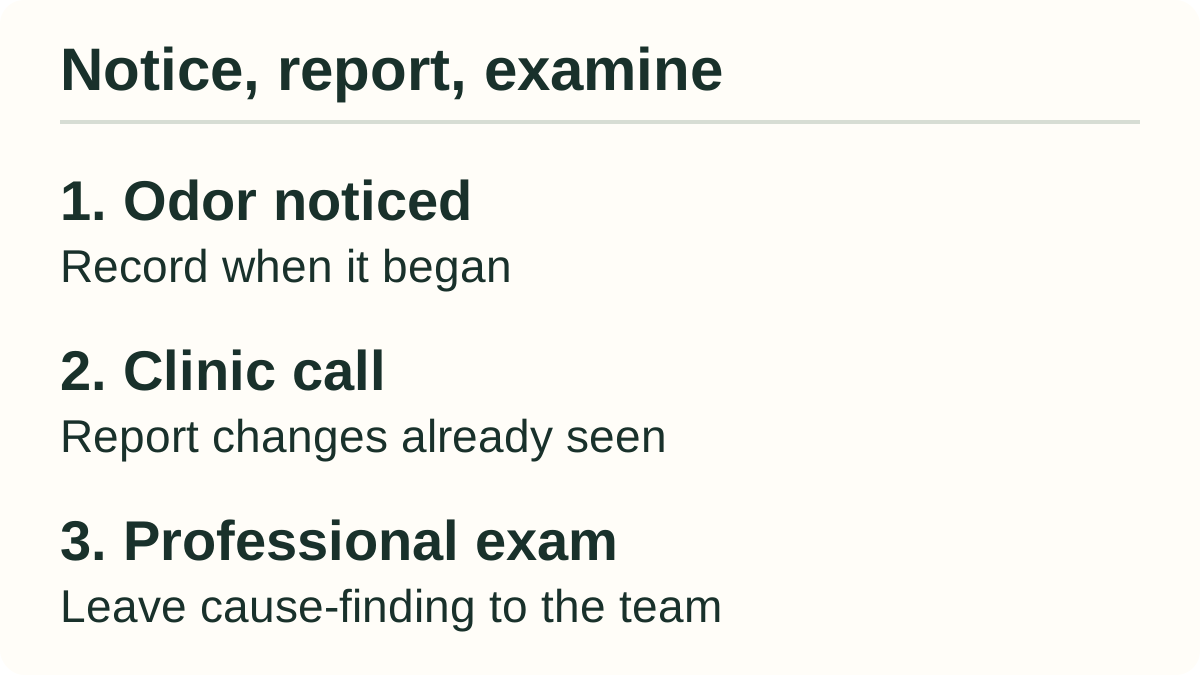
What to tell the veterinary clinic
Write down only the short history you already know:
- when you first noticed the change and whether it has been consistent;
- whether it appears after a particular meal or at another time;
- any drooling, food falling during chewing, eating difficulty, reduced appetite, weight change, or low energy you have already seen.
These details help the clinic decide what to ask next. They do not diagnose a dental or non-dental condition. AAHA's dental-care guidance places bad breath and related mouth or eating changes in a professional-care conversation; one sign does not establish severity.
A concise call can sound like this:
“My senior cat has had new or persistent bad breath since [time]. I have already noticed [brief visible change], and [the odor is still present or it has changed]. I have not tried to inspect or treat the mouth. How soon should we arrange an examination?”
Leave out guesses about the source. If you are unsure whether a change matters, say exactly that and ask the clinic how to proceed.
Leave cause and treatment to the clinic
A freshener cannot identify the cause of persistent or recurring odor. Use the call template above and let the veterinary team advise on assessment and treatment; do not delay that contact to try a home product.
If the main change is food dropping from the mouth while chewing, see Cat Dropping Food but Still Hungry? Look Beyond Appetite for that separate observation. This page keeps the question narrower: what a new or persistent odor can tell you, what it cannot, and what to report before a professional examination.
Research notes
Sources behind this guide
Written and source-checked by Puni Pet Guides Editorial Team · Reviewed Oct 5, 2026
This guide synthesizes the public references below; it does not report hands-on product testing or independent veterinary review.
Review scope: practical context, source traceability, and clear non-diagnostic boundaries. Diagnosis and treatment decisions stay with veterinarians.