
Everyday dog care · color vision
What Colors Can Dogs See? Blue, Yellow, and the Limits
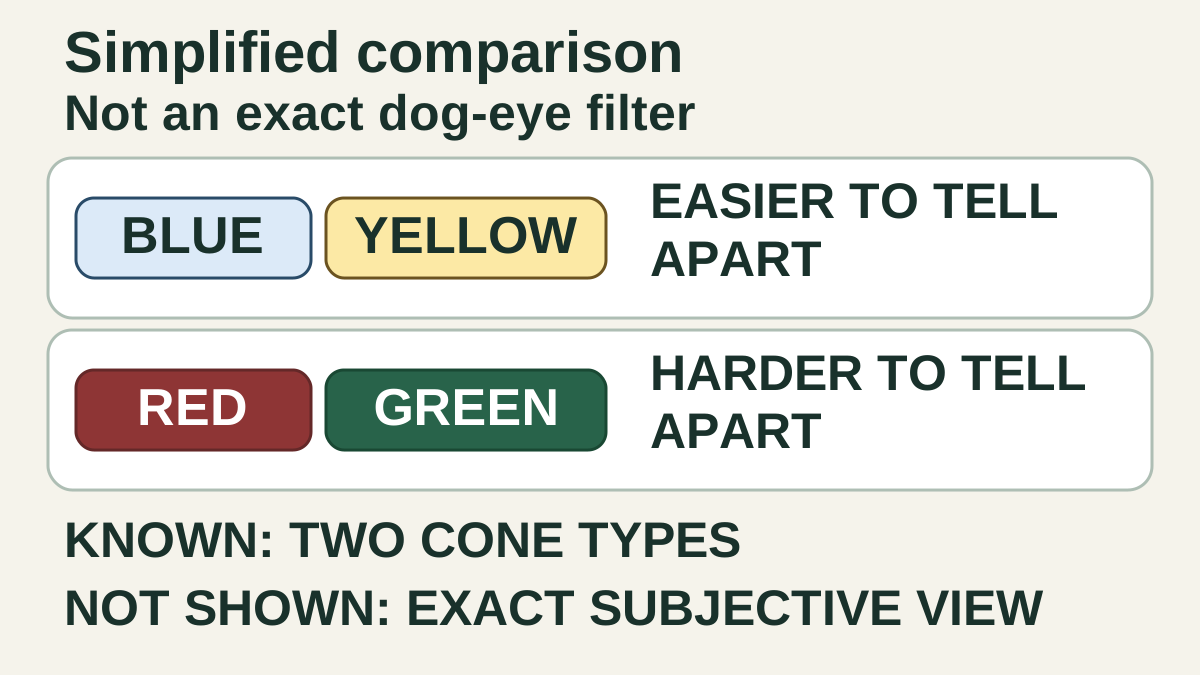
Dogs can see color; their color vision uses two types of color-sensitive cone cells. Veterinary sources describe broad blue and yellow distinctions and say red and green are harder for dogs to tell apart. This is a useful summary, not an exact picture of what a dog sees.

What the two cone types explain
The American College of Veterinary Ophthalmologists describes canine cone responses in blue-violet and greenish-yellow ranges. Those terms describe reported response ranges. “Blue” and “yellow” are broad shorthand, not a precise palette of the colors a dog experiences.
People typically have three cone types, while dogs have two, according to the American Kennel Club’s veterinarian Q&A on canine vision. The difference helps explain why dogs distinguish among colors less finely than people. It does not mean they see only in black and white.
What the research does not show
A 1989 behavioral study tested color discrimination in three dogs and reported results consistent with two cone photopigment classes. It supports the basic two-cone model. The small study cannot map the exact subjective look of a scene for every dog, and it does not establish whether a particular toy or object will stand out to an individual dog. Read the PubMed abstract for “Color vision in the dog”.
The useful takeaway is broad: blue and yellow are easier to distinguish than red and green, but these sources do not map the exact shades an individual dog sees.
Research notes
Sources behind this guide
Written and source-checked by Puni Pet Guides Editorial Team · Reviewed Oct 26, 2026
This guide synthesizes the public references below; it does not report hands-on product testing or independent veterinary review.
Review scope: practical context, source traceability, and clear non-diagnostic boundaries. Diagnosis and treatment decisions stay with veterinarians.