
Senior cat care · repeated localized licking
Senior Cat Overgrooming One Spot? Don’t Assume Stress
If a senior cat keeps licking one spot and the fur is thinning, becoming bare, red, or raw, record what you can already see and contact your veterinary team. The location does not prove stress or another cause. Cornell's feline health guidance treats excessive licking as a sign needing cause assessment, while VCA's cat-illness guidance describes several possible contexts for excessive grooming.
Do not restrain or repeatedly touch the area, or apply a topical treatment while trying to find the cause.
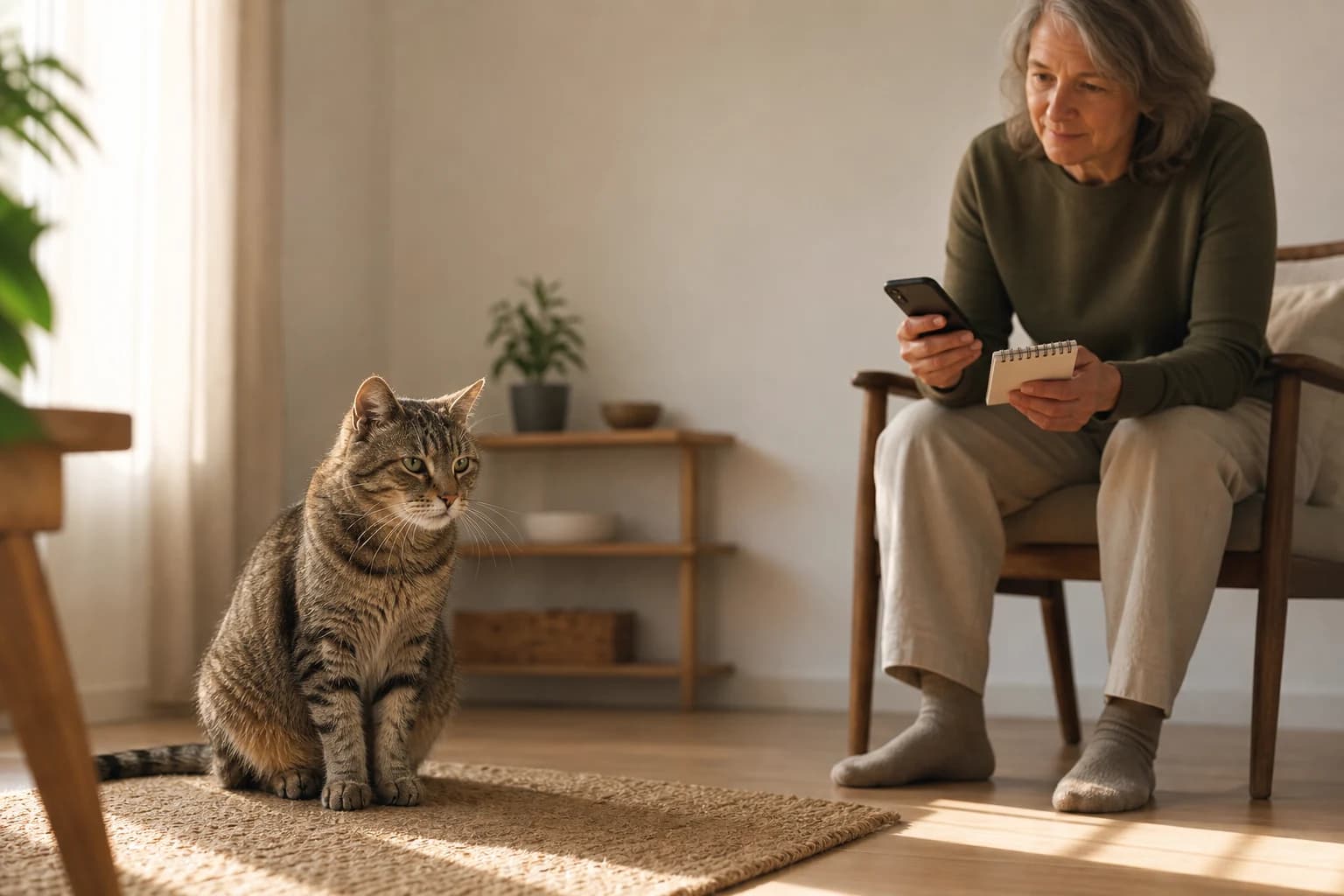
Repeated licking is a sign, not a stress diagnosis
Cornell's feline health guidance says excessive licking calls for assessment of its cause; the body area alone cannot settle that question. VCA's guidance lists skin problems, parasites, pain, and stress among possible contexts and notes that focal licking can leave bald, red, or raw areas. These are reasons to describe the sign accurately, not labels to assign at home.
| Already observed | Not established by the spot |
|---|---|
| The cat repeatedly licks one area and the fur looks thinner | “That location proves stress” |
| Bare, red, raw, damp, swollen, or otherwise changed skin already visible | “The appearance identifies a parasite, pain, or another cause” |
| When you first noticed it and another change already seen | “No other obvious sign means it is harmless” |
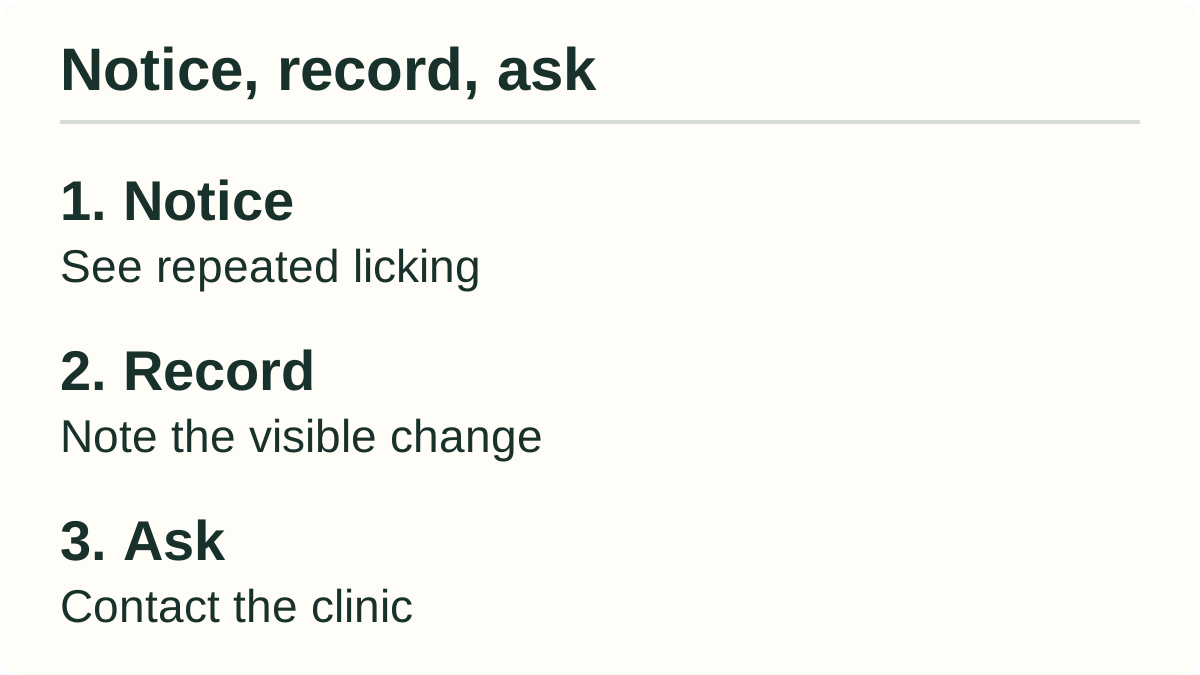
Record only what is already visible
Keep the history short enough to give over the phone:
- the body area and when you first noticed the repeated licking;
- whether it is occasional, frequent, or a clear change from the usual routine, if you happened to observe that pattern;
- what the fur or skin already looks like from a normal distance, such as thinning, bare, red, raw, wet, swollen, or marked by discharge, odor, or bleeding;
- other changes you already noticed, without trying to create a complete examination at home.
A dated photograph can show change if the cat is relaxed and the picture needs no moving, restraining, or parting of fur. Stop if your cat pulls away, stiffens, vocalizes, swats, hides, or resists. Do not shave, pull at the coat, scrub the skin, or keep checking after the cat asks for space.
When the observation becomes a call
Call the veterinary team instead of continuing to handle the spot if you see raw or broken skin, bleeding, discharge, swelling, a strong pain response, or clear worsening. You do not need to decide whether the cause is behavioral, skin-related, painful, or something else. Report the sign and how your cat responded.
A concise call can sound like this:
“My senior cat has been repeatedly licking the same area since [time]. I have already noticed [thinning, bare, red, raw, or other visible change]. My cat [did or did not] resist when I looked from a normal distance. I have not restrained the area or applied a topical product. What history should I bring, and how should we arrange an examination?”
That keeps the report factual and leaves cause-finding to the veterinary team.
If the concern is reduced grooming, a greasy coat, or a tight mat, see Senior Cat Not Grooming? What to Check With Matted Fur.
Research notes
Sources behind this guide
Written and source-checked by Puni Pet Guides Editorial Team · Reviewed Oct 5, 2026
This guide synthesizes the public references below; it does not report hands-on product testing or independent veterinary review.
Review scope: practical context, source traceability, and clear non-diagnostic boundaries. Diagnosis and treatment decisions stay with veterinarians.