
Dog mobility · household stairs
Dog Slipping on Wood Stairs? Start With Access and the Exact Surface
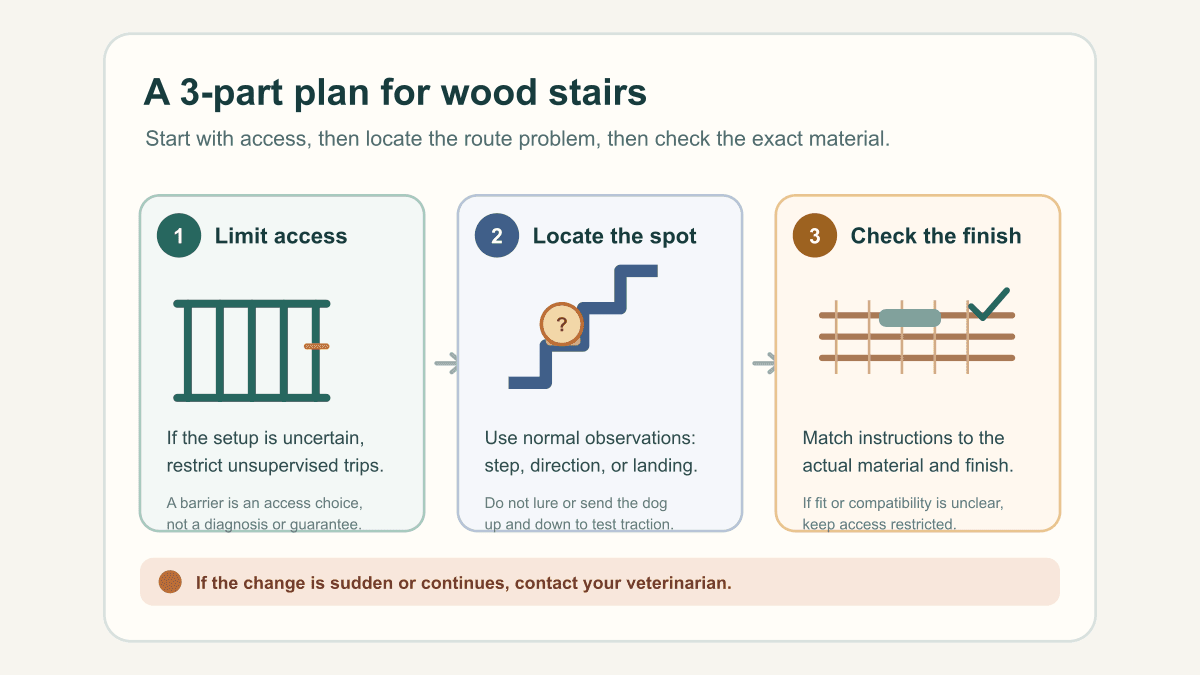
If a dog is slipping on wood stairs, first limit unsupervised trips while you check the route. Note where the slip happens, then confirm that any traction material is approved for the exact stair surface and finish. A carpeted furniture step is a different setup from a household staircase, and one product’s instructions should not be applied to another.
If the change is sudden or your dog continues to hesitate or slip, speak with your veterinarian before treating it as only a home-surface problem. Do not make your dog repeat the staircase to test a new setup.
Limit unsupervised access while you assess the route
If you are not confident the staircase is suitable for your dog right now, use a gate or another appropriate barrier to restrict access without blocking people’s normal passage. The American Kennel Club includes gates among the ways to restrict a dog with mobility issues from home stairs. A barrier is a temporary access choice; it does not tell you why the dog slipped or whether the stairs are appropriate for supervised use.
The AAHA life-stage safety guidance recommends providing traction on floors and stairs or changing routines to reduce stair climbing as appropriate. That gives you two practical questions: can you limit the trips, and is there a surface change that fits these exact stairs?
Locate the part of the route that needs attention
Use what you have already observed during normal movement. Make a note of whether the slipping occurs going up or down, at a particular tread, on the landing, or where the stair meets a smooth floor. Do not call your dog to the stairs, lure it with food, or ask it to repeat a run for a comparison.
If you already have a short video from ordinary movement that did not put your dog at risk, the AAHA senior-pet evaluation guidance says videos can give a veterinary team additional information about mobility and movement. You can also describe what you noticed and when it began. A video or note is context for the conversation, not a diagnosis.
Check the actual stair surface before choosing a covering
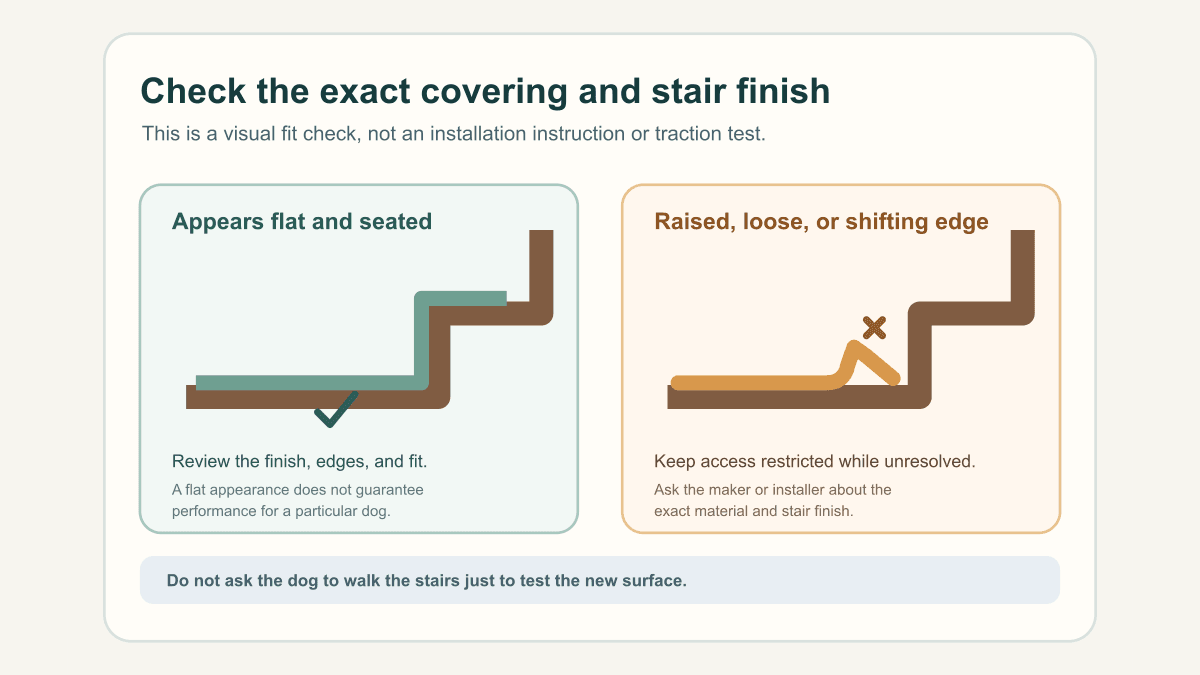
“Wood stairs” can describe different finishes and surfaces. Before choosing adhesive treads, carpet pieces, or another covering, identify the finish and read the instructions for that exact material. If you rent or do not own the staircase, check what changes are allowed. Ask the product maker or a qualified installer whether the material is compatible with that finish and intended use.
Look at whether a covering is meant for an indoor stair tread, whether it can cover the area your dog actually steps on, and whether its maker gives instructions for your specific surface. Do not assume that a strip made for shoes is suitable for paws. Do not sand, paint, glue, or apply a coating to finished stairs based on a generic online tip.
Before opening the route, inspect the setup without your dog on the stairs. If an edge is raised, a piece shifts, or the manufacturer’s surface requirements are unknown, keep access restricted while you resolve that question. Follow the chosen maker’s exact installation, cure, cleaning, and removal guidance; those details vary by material and finish.
Keep household stairs separate from furniture steps
Small dog steps can help some dogs reach a bed or couch, but they are not a replacement for a household stair flight. Puni Pet’s ramp-versus-stairs guide separates those access points and advises against using furniture steps to solve whole-home stairs. For a dog slipping on wood stairs, focus on controlling access and checking the actual stair surface.
For slipping across a hallway or other flat hard floors, see the broader senior dog hardwood-floor guide. It covers route mapping and floor traction beyond the staircase.
Keep footing and willingness as separate observations
A surface setup and a dog’s willingness to use the stairs are two separate observations. A material choice addresses the route; it does not explain why a dog continues to hesitate or slip. Use what you have already seen during ordinary movement, and do not stage another stair run to check.
When to contact your veterinarian
If the slipping started suddenly, continues, or comes with a new reluctance to use familiar stairs, contact your veterinarian. Home changes can address the route, but they cannot determine the reason for a change in movement. Share what you observed and any safe, ordinary-movement notes or video; let the veterinary team assess what it means.
A short checklist
- Limit unsupervised access while the setup is uncertain.
- Note the step, direction, or landing involved from normal observation; do not stage a test.
- Confirm that the selected material’s instructions match the exact stair finish and intended use.
- Keep the route restricted if a covering is loose, raised, shifting, or not confirmed compatible.
- Ask a veterinarian about sudden or continuing changes.
Research notes
Sources behind this guide
Written and source-checked by Puni Pet Guides Editorial Team · Reviewed Oct 5, 2026
This guide synthesizes the public references below; it does not report hands-on product testing or independent veterinary review.
Review scope: practical context, source traceability, and clear non-diagnostic boundaries. Diagnosis and treatment decisions stay with veterinarians.
This guide offers home-setup context. It does not report hands-on testing or independent veterinary review, and it does not diagnose or treat a health condition.