
Will an Air Purifier Help With Litter Box Smell?
An air purifier may help with airborne particles or some odor gases, depending on its filters. A suitable particle filter can reduce dust in the air, while a gas-targeted filter with a substantial amount of activated carbon or other gas-filter media may reduce some odor-related gases. A clean air delivery rate (CADR) number alone does not show that a purifier will reduce litter smell, and no cleaner removes every pollutant. Start by addressing the litter-box source, then check filter type and room coverage. EPA
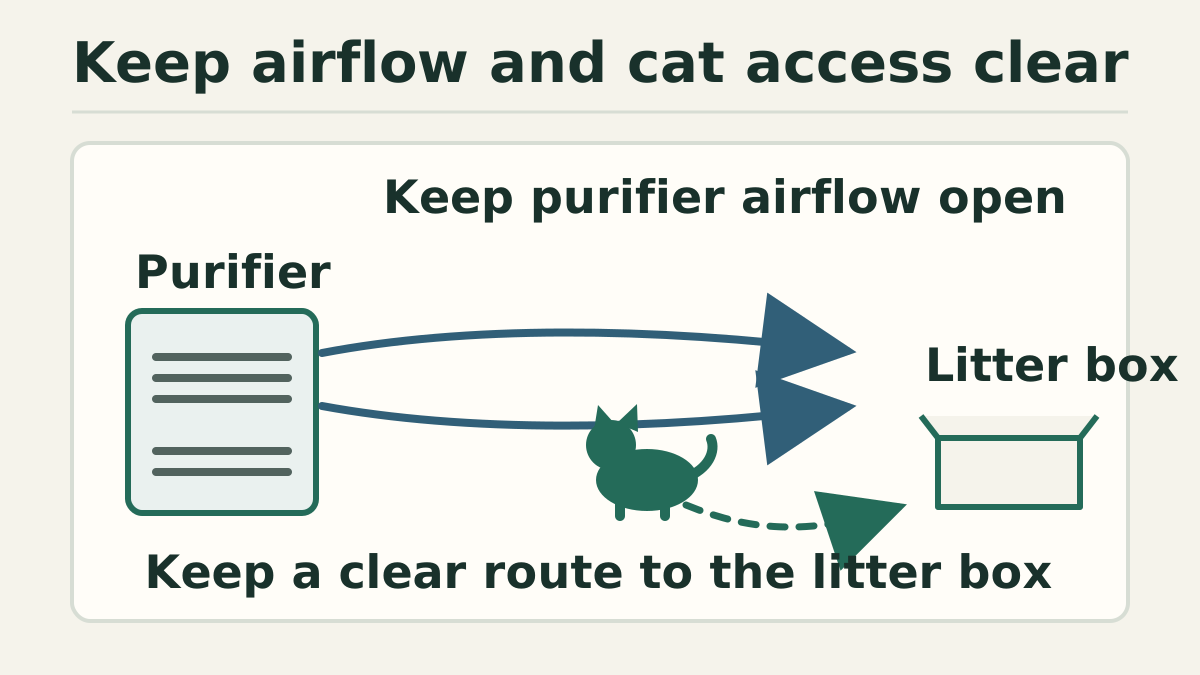
Start with the litter box
Use an air cleaner as a supplement to source control. The EPA says the most effective ways to improve indoor air are to reduce or remove pollutant sources and ventilate with clean outdoor air. Filtration can help, but it cannot remove all pollutants. EPA
For the litter itself, the American Association of Feline Practitioners (AAFP) advises scooping once or twice daily and changing and cleaning the box regularly. This is routine box care, not a promise that every room odor will disappear. AAFP
In a multi-cat home, the AAFP advises one litter box per cat plus one extra. Keep boxes in separate areas, with at least one on each floor and easy access. When placing an air cleaner, leave a clear path to the box. AAFP For a related layout question, see our senior-cat litter-box placement guide.
If your cat starts avoiding the box or soiling outside it, ask your veterinarian to assess the change. The AAFP advises ruling out underlying medical problems before or while investigating inappropriate elimination or spraying. AAFP
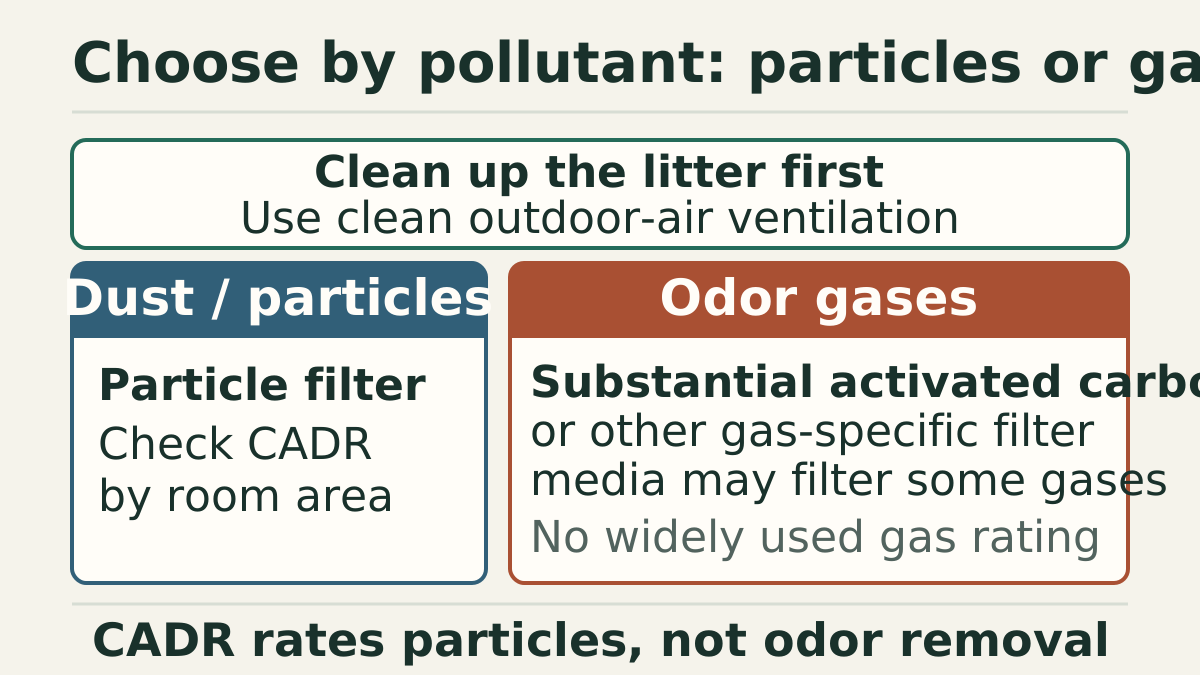
Particles and odor gases need different filters
| Your main concern | What to look for |
|---|---|
| Airborne particles, such as dust | A particle filter and a CADR matched to the room or area served. CADR rates particle removal. EPA |
| Odor-related gases | Substantial activated carbon or other media designed for gases. There is no widely used gas-removal rating, and CADR does not measure odor removal. EPA |
What to check before buying
- For odor: Read the filter label for activated carbon or other gas-targeted media. EPA guidance says activated carbon can be effective when there is a large amount of material, but there is no widely used rating system for comparing gas-removal performance. EPA
- For dust: Check the particle CADR against the room size on the product label. If the purifier would serve an open-plan area, consider the full area rather than only the corner beside the box. EPA
- For day-to-day use: Keep the air intake and outlet clear of curtains or other obstructions. Higher fan speeds and longer run times generally filter more air, and filters need replacement; a dirty, overloaded filter will not work well. Follow the maker’s replacement directions. EPA
- For product claims: Do not treat a high CADR as proof of odor removal. The EPA does not certify or recommend specific air-cleaner brands or models. EPA
Avoid devices that intentionally generate ozone as a litter-odor fix. Ozone is a lung irritant. The EPA says ozone at concentrations that do not exceed public-health standards has little potential to remove indoor contaminants and is not effective at removing many odor-causing chemicals. It may mask an odor rather than remove it, so a weaker smell alone does not show that the source is gone. EPA
Keep the litter area clean and the box easy to reach first. AAFP If you still want an air cleaner, use particle CADR and room coverage to assess dust filtration. For odor, look for substantial gas-filter media, but do not assume the available rating information guarantees a particular result. EPA
Research notes
Sources behind this guide
Written and source-checked by Puni Pet Guides Editorial Team · Reviewed Nov 14, 2026
This guide synthesizes the public references below; it does not report hands-on product testing or independent veterinary review.
Review scope: practical context, source traceability, and clear non-diagnostic boundaries. Diagnosis and treatment decisions stay with veterinarians.